
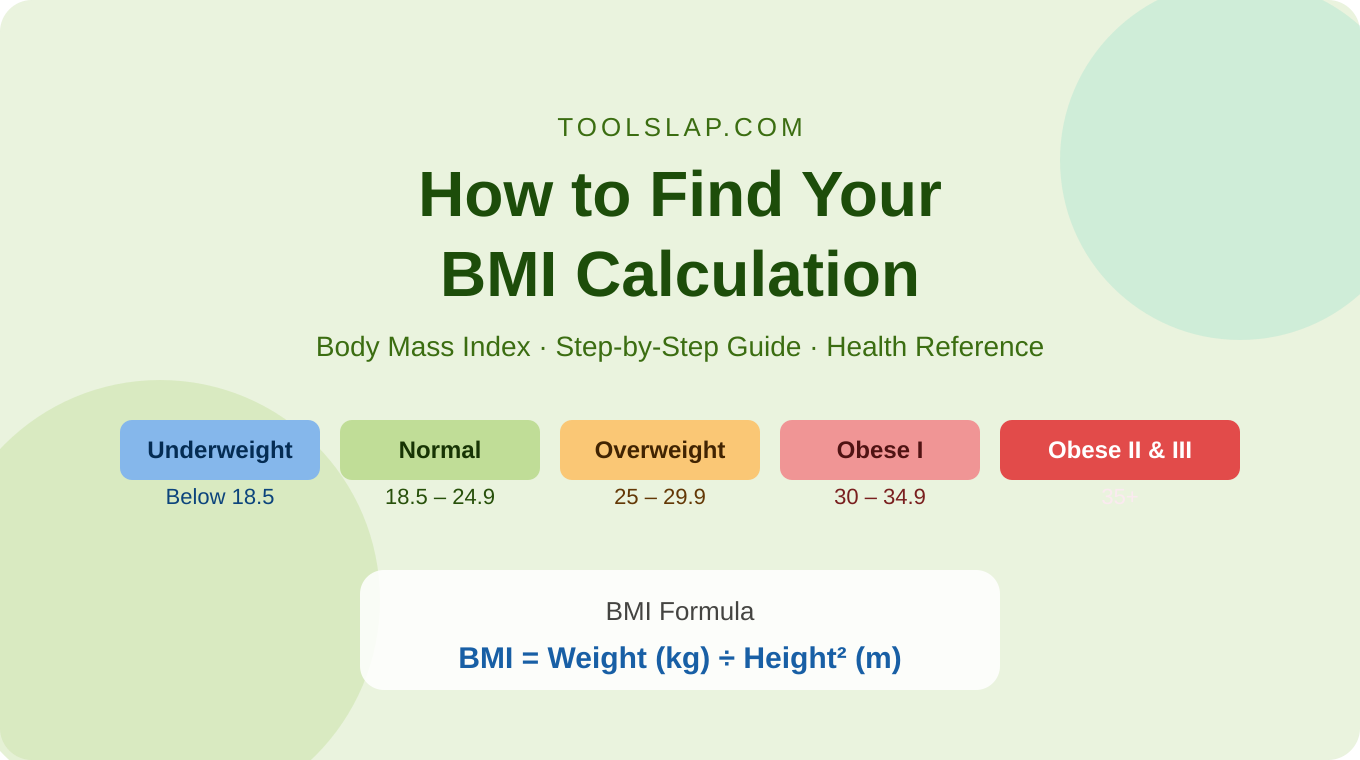
If you have ever wondered whether your weight is healthy for your height, BMI is one of the first numbers health professionals look at. In this guide, you will learn exactly how to find your BMI calculation, what the result means, and how to use it as a starting point for a healthier life.
BMI stands for Body Mass Index. It is a numerical value calculated from a person’s weight and height. The concept was introduced in the early 19th century by Belgian mathematician Adolphe Quetelet and has been widely used by the World Health Organization (WHO) and health practitioners around the world as a quick screening tool to categorize weight status.
BMI does not directly measure body fat, but it provides a reliable indicator of whether a person may be underweight, at a healthy weight, overweight, or obese. It is inexpensive, non-invasive, and easy to calculate, which is why it remains one of the most commonly used health metrics globally.
Understanding your BMI calculation can help you take proactive steps toward better health. Here is why it matters:
It helps identify potential weight-related health risks early. People with a high BMI have a greater chance of developing conditions such as type 2 diabetes, heart disease, high blood pressure, and certain cancers. On the other end, a very low BMI can signal malnutrition, eating disorders, or other underlying health concerns.
Knowing your BMI also helps you set realistic, measurable health goals. Instead of focusing only on how you look or feel, you can track a concrete number that reflects your progress over time.
The standard BMI formula is straightforward. There are two versions depending on the measurement system you use.
Metric system (kilograms and meters): BMI = Weight in kilograms ÷ (Height in meters × Height in meters)
Imperial system (pounds and inches): BMI = (Weight in pounds ÷ (Height in inches × Height in inches)) × 703
Both formulas give you the same result. The only difference is the unit system you start with.
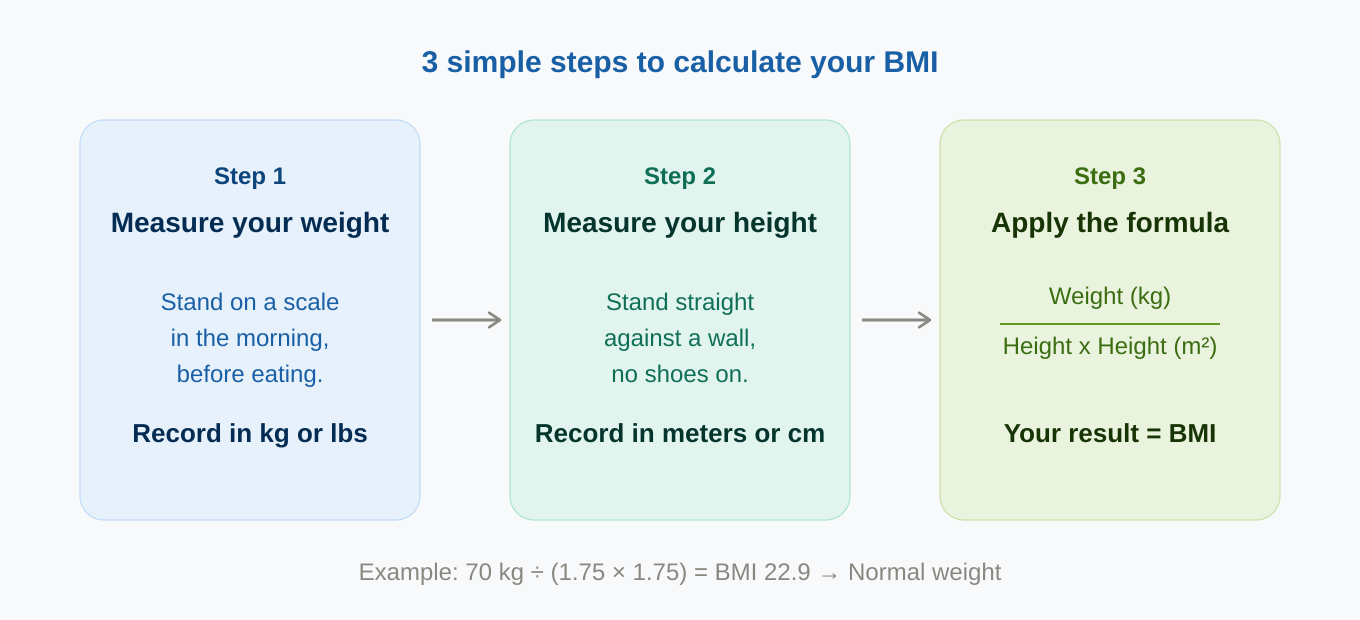
Follow these three steps to calculate your BMI accurately.
Step 1 – Measure your weight correctly
Weigh yourself first thing in the morning, before eating or drinking anything. Wear minimal clothing and no shoes. Use a digital scale placed on a hard, flat surface for the most accurate reading. Record your weight in kilograms (kg) or pounds (lbs).
Step 2 – Measure your height correctly
Stand straight against a flat wall with no shoes on. Keep your heels together, your back flat against the wall, and look straight ahead. Use a measuring tape or stadiometer and record your height in meters (m) or inches (in). If you only know your height in centimetres, divide by 100 to convert to meters. For example, 175 cm becomes 1.75 m.
Step 3 – Apply the formula
Now plug your numbers into the formula.
Example using metric units: A person who weighs 70 kg and stands 1.75 m tall would calculate their BMI like this — 70 ÷ (1.75 × 1.75) = 70 ÷ 3.0625 = 22.86. That gives a BMI of approximately 22.9, which falls in the Normal weight category.
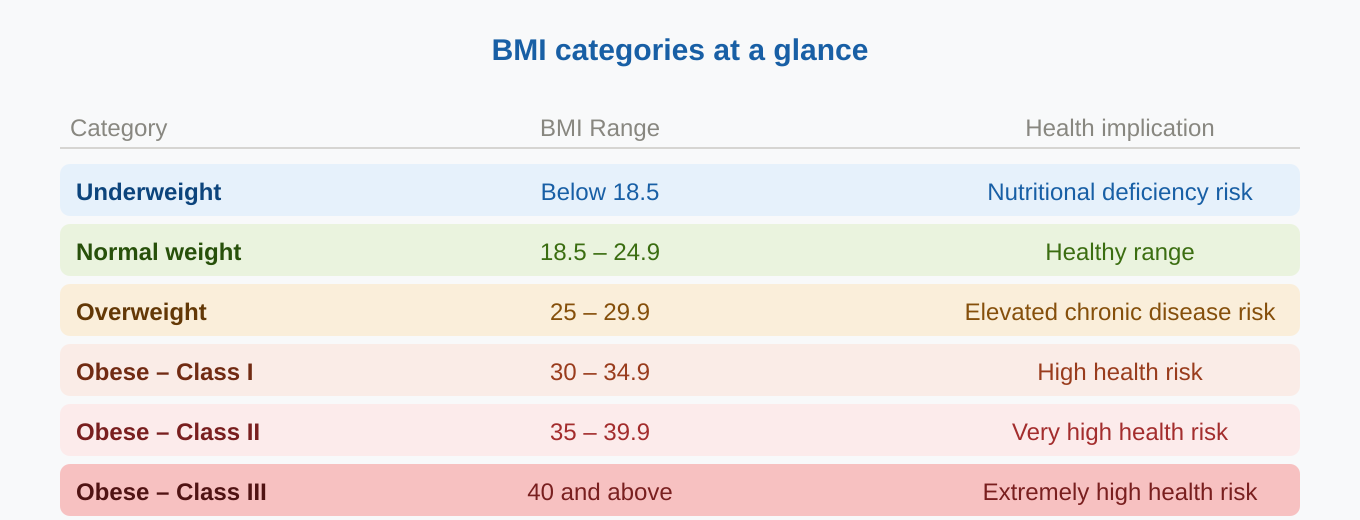
Once you have your number, use the WHO’s standard BMI categories to understand what it means for your health.
A BMI below 18.5 is considered underweight. This can indicate insufficient nutrition and may be linked to weakened immunity or bone density issues.
A BMI between 18.5 and 24.9 is considered normal or healthy weight. This range is associated with the lowest risk of weight-related diseases for most adults.
A BMI between 25 and 29.9 is classified as overweight. This range signals a slightly elevated risk of developing chronic conditions, though other factors like fitness level and diet also matter.
A BMI between 30 and 34.9 falls under Obese Class I. Health risks are high and medical guidance is often recommended.
A BMI between 35 and 39.9 is Obese Class II, carrying very high health risks and often requiring professional intervention.
A BMI of 40 or above is classified as Obese Class III (also called severe or morbid obesity), which carries the greatest risk of serious health complications.
The same BMI formula is used for both men and women. However, it is important to note that men and women naturally carry body fat differently. Women tend to have a higher percentage of body fat at the same BMI compared to men. Despite this, the WHO still uses the same cut-off points for both sexes as a general screening tool, though some clinicians account for sex-specific differences in follow-up assessments.
The standard adult BMI chart does not apply to children and adolescents. For people under the age of 20, BMI is still calculated the same way, but it is interpreted differently using age- and sex-specific percentile charts developed by the Centers for Disease Control and Prevention (CDC). A BMI in the 5th to 84th percentile is considered healthy for children, while a result at or above the 95th percentile is classified as obese.
BMI is a useful screening tool, but it has well-documented limitations that are important to understand.
It does not distinguish between fat mass and muscle mass. A highly muscular athlete may have a BMI in the overweight range despite having very low body fat. Conversely, someone with a normal BMI can still carry excess fat in dangerous areas, particularly around the abdomen.
BMI also does not account for fat distribution. Visceral fat — the fat stored around the abdominal organs — is far more dangerous to health than subcutaneous fat stored under the skin. Tools like waist circumference measurements and waist-to-hip ratio provide a complementary picture when used alongside BMI.
Furthermore, BMI ranges may not apply equally across all ethnicities. Research suggests that people of Asian descent may face elevated health risks at lower BMI thresholds, and the WHO has acknowledged alternative cut-off points for specific populations.
Because of these limitations, BMI is best used as a starting point, not a definitive health diagnosis. Always consult a qualified healthcare professional for a full health assessment.
If you are more comfortable with pounds and feet, here is how the imperial calculation works.
Say a person weighs 155 pounds and is 5 feet 7 inches tall. First convert the height entirely to inches — 5 feet × 12 = 60 inches, plus 7 more = 67 inches total.
Then apply the formula: (155 ÷ (67 × 67)) × 703 = (155 ÷ 4489) × 703 = 0.03453 × 703 = 24.28. A BMI of 24.28 falls in the Normal weight range.
If you want a rough estimate without doing the full math, you can use this simplified approach. Take your weight in kilograms. Divide it by your height in meters squared. Round to the nearest whole number. Compare with the WHO category table.
You can also use Toolslap’s free online BMI calculator to get your result instantly — just enter your weight and height and the tool does the rest. It is fast, private, and requires no sign-up.
If your BMI result puts you outside the healthy range, there are proven, evidence-based steps you can take to work toward a healthier number.
For those in the overweight or obese range, even a modest weight loss of 5 to 10 percent of your total body weight can significantly reduce health risks. Focus on a sustainable caloric deficit through whole foods, reduced ultra-processed food intake, and daily physical activity of at least 150 minutes per week as recommended by the WHO.
For those in the underweight range, working with a registered dietitian to gradually increase caloric intake through nutrient-dense foods — including healthy fats, lean proteins, and complex carbohydrates — is the safest approach.
In all cases, consistency matters more than speed. Rapid weight changes, whether loss or gain, carry their own set of health risks.
Learning how to find your BMI calculation is a simple but genuinely useful step toward understanding your health. With just your weight and height, and a straightforward formula, you can get a meaningful number that tells you where you stand and helps guide your next steps.
Remember, BMI is not the whole picture — it is the beginning of the conversation. Use it alongside other health indicators, lifestyle habits, and professional guidance to build a clearer, more complete view of your wellbeing.
Ready to find your number right now? Use the free BMI calculator on Toolslap and get your result in seconds.
Checking your BMI every three to six months is reasonable for most adults. This gives enough time for meaningful changes to take place while keeping you informed of your progress.
No. BMI is a ratio of weight to height. Body fat percentage measures how much of your total body weight is composed of fat tissue. The two are related but not the same.
Yes. A person with a normal BMI can still have high blood pressure, elevated cholesterol, or poor metabolic health. BMI is one data point among many.
A BMI between 18.5 and 24.9 is generally considered a healthy range for most adults according to the WHO.
Yes. Because height is squared in the formula, even small differences in height significantly change your BMI result. A person who is 10 centimetres shorter than another but weighs the same will have a noticeably higher BMI.