
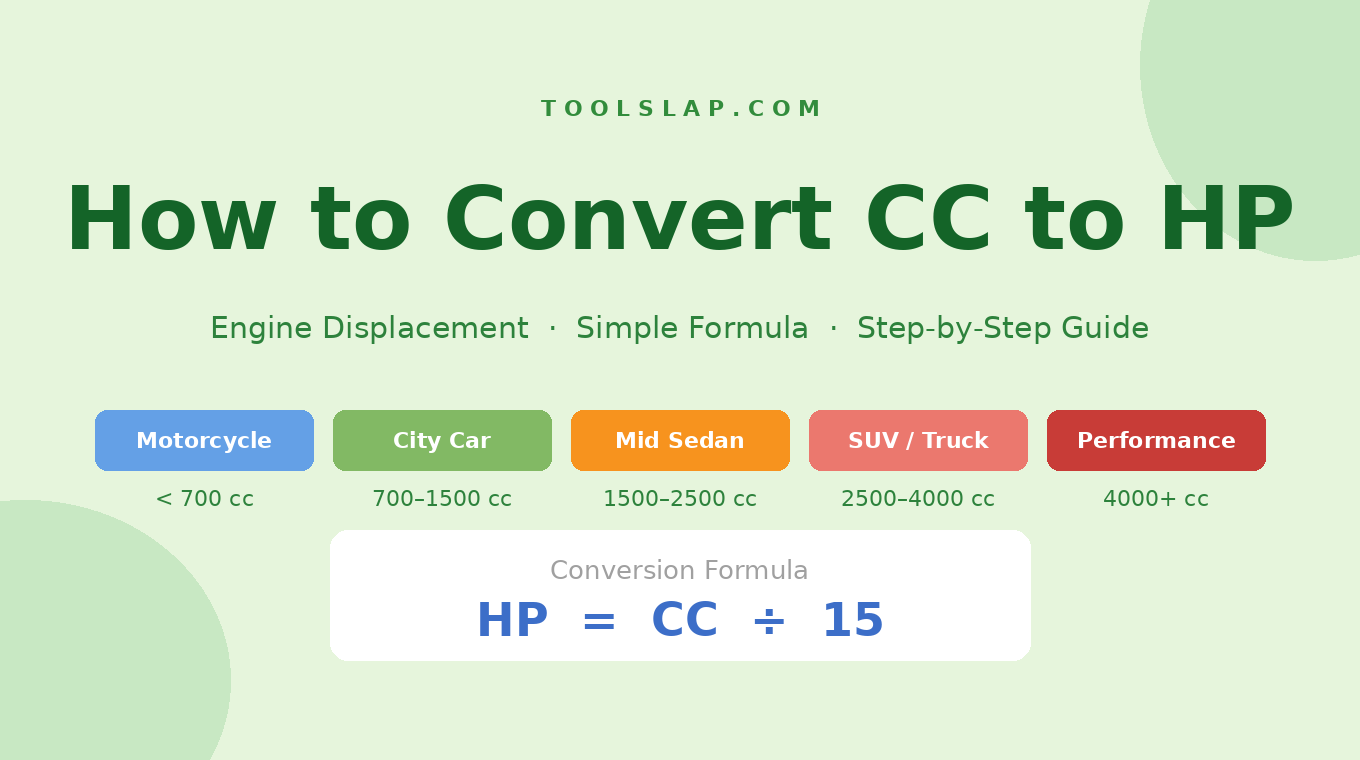
If you’ve ever looked at an engine spec sheet and seen “1500cc” or “650cc” written on it, you’ve probably wondered — okay, but how much horsepower is that? You’re not alone. A lot of car enthusiasts, bike buyers, and even mechanics ask this same question. The good news is converting CC to HP isn’t complicated once you know what you’re dealing with.
Let’s break it all down in simple, plain English.
CC stands for Cubic Centimeters. It refers to the total volume of all the cylinders inside an engine — combined. This measurement tells you how much air and fuel the engine can pull in during each cycle.
A bigger CC number means a larger engine. A larger engine generally means more power potential. But here’s the catch — CC alone doesn’t tell you horsepower directly. It just tells you how big the engine is.
Think of it like a kitchen. CC is the size of your pots. HP is how fast you can cook dinner. A bigger pot doesn’t automatically mean faster cooking — it depends on the stove, the heat, and how efficiently you use everything.
HP stands for Horsepower. It’s the actual measure of power output that an engine produces. Horsepower tells you how fast an engine can do work — essentially, how hard it can push the vehicle forward.
One horsepower equals the power needed to lift 550 pounds one foot in one second. That’s the old-school engineering definition, and it still holds today.
Modern engines are rated in horsepower so buyers and engineers can compare performance across different vehicles fairly.
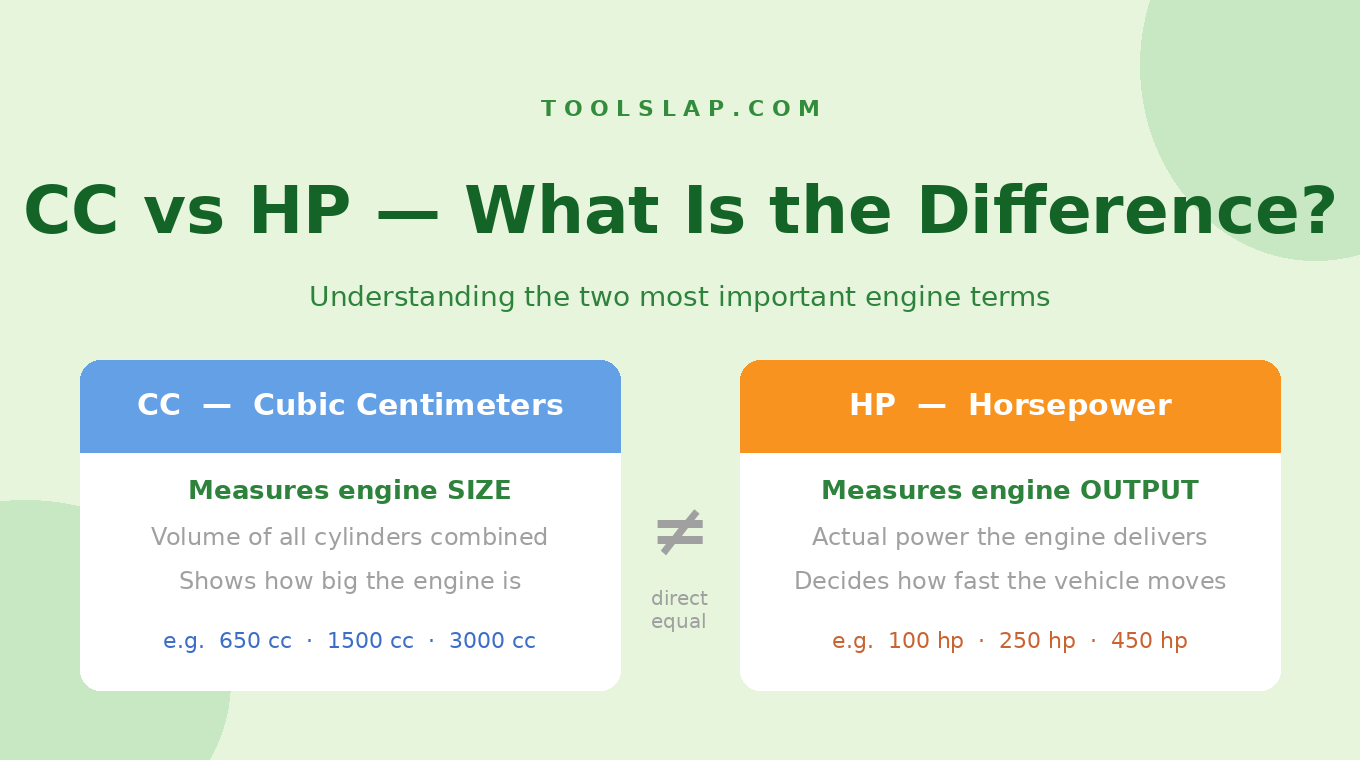
Here’s where things get a little interesting. There is no single universal formula that converts CC to HP with 100% accuracy. Why? Because horsepower depends on many things — not just engine size. It depends on the engine’s design, compression ratio, fuel type, turbocharging, valve timing, and more.
However, there is a widely used rule of thumb that works as a reasonable estimate for naturally aspirated (non-turbocharged) engines:
The General Formula:
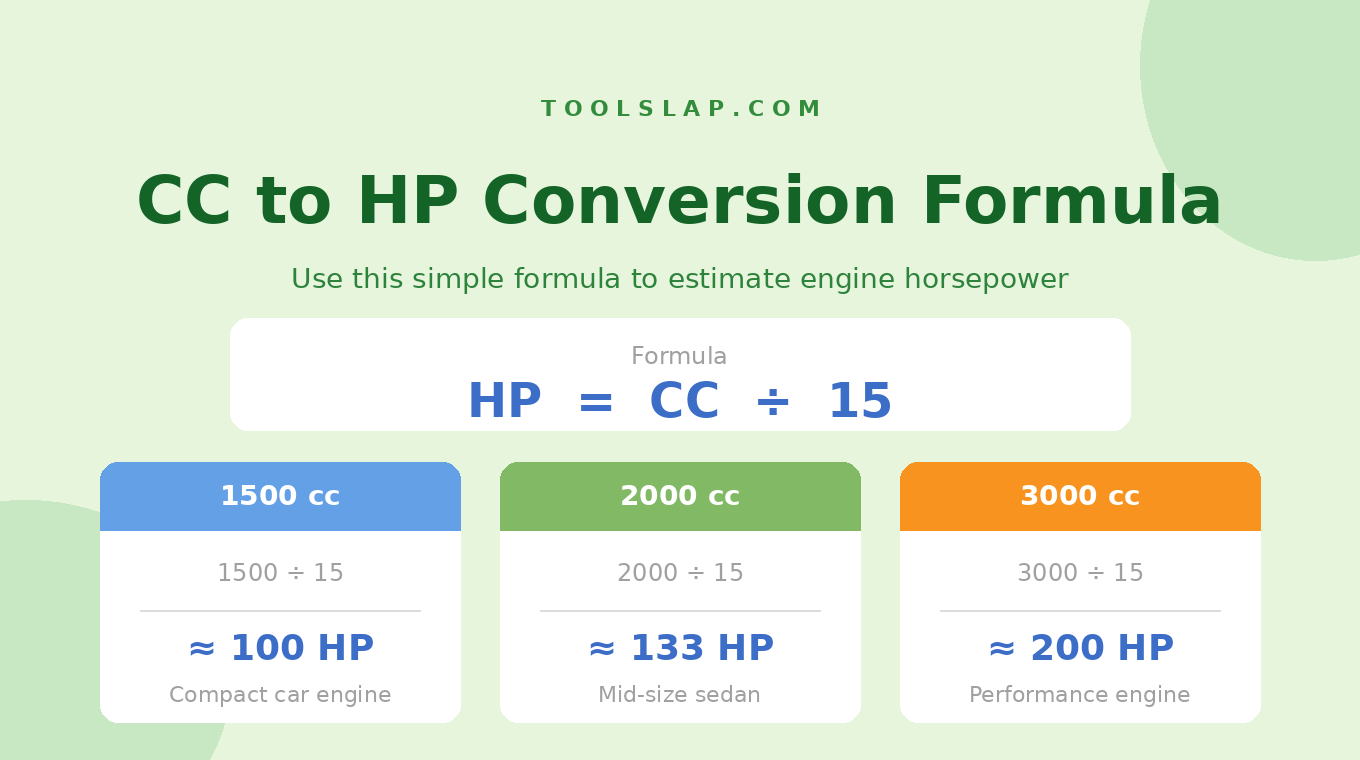
HP = CC ÷ 15
This means for every 15 cubic centimeters of engine displacement, you get approximately 1 horsepower.
So a 1500cc engine would give you roughly 100 HP. A 3000cc engine would give you around 200 HP. It’s a ballpark figure — not a certified engineering value — but it’s extremely useful for quick comparisons.
Let’s walk through the process nice and easy.
Step 1 — Find the CC value of your engine. This is usually listed in the vehicle’s spec sheet, owner’s manual, or on the manufacturer’s website. It might also be written on the engine block itself.
Step 2 — Apply the formula. Take the CC value and divide it by 15.
Step 3 — Read your result. The number you get is the approximate horsepower of that engine.
That’s genuinely it. No complicated math required.
Let’s look at some practical examples you might actually encounter.
A 600cc motorcycle engine typically produces around 40 HP when it’s a basic commuter bike engine. A sports motorcycle with the same 600cc might produce 95–120 HP because of performance tuning and high-compression design — this perfectly shows why the formula gives an estimate, not a guaranteed number.
A 1000cc car engine in a small hatchback might put out about 65–70 HP. A 1000cc engine in a sporty compact with turbocharging could push 130 HP. Same displacement, nearly double the power.
A 5000cc V8 truck engine might produce 300–400 HP depending on its tuning, compression, and aspiration. So you can see the relationship is directional, not fixed.
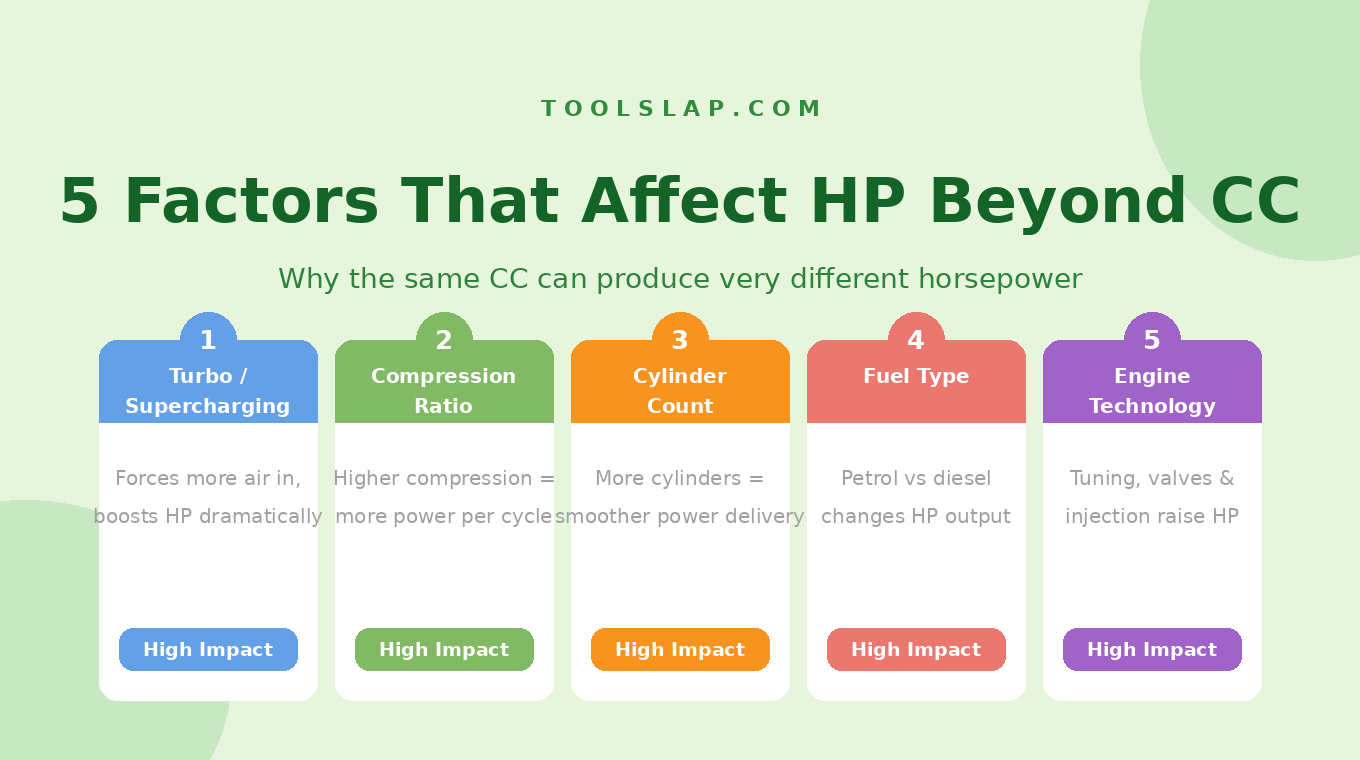
This is the question most people have but don’t ask. Here’s a simple breakdown of the factors that affect how much HP a given CC engine actually produces.
Turbocharging and Supercharging — Forced induction pumps more air into the same cylinder, allowing more fuel to burn, which produces significantly more power from the same displacement. A turbocharged 1000cc engine can easily produce twice the HP of a naturally aspirated one.
Compression Ratio — Engines with a higher compression ratio squeeze the air-fuel mixture tighter before ignition, releasing more energy per cycle. Higher compression means more HP from the same CC.
Number of Cylinders — A 2000cc engine with 4 cylinders and a 2000cc engine with 6 cylinders will behave differently in terms of smoothness and power delivery, even if the total displacement is equal.
Engine Technology — Modern engines with variable valve timing, direct injection, and electronic management systems extract far more HP per CC than older carbureted engines of the same size.
Fuel Type — Diesel engines tend to produce more torque but fewer horsepower compared to petrol engines of similar displacement. The formula CC ÷ 15 applies best to petrol engines.
Here’s a handy reference for common engine displacements and their approximate horsepower based on the standard formula. Remember these are estimates for naturally aspirated engines.
| Engine CC | Approximate HP |
|---|---|
| 100 cc | ~7 HP |
| 150 cc | ~10 HP |
| 250 cc | ~17 HP |
| 500 cc | ~33 HP |
| 600 cc | ~40 HP |
| 1000 cc | ~67 HP |
| 1500 cc | ~100 HP |
| 2000 cc | ~133 HP |
| 2500 cc | ~167 HP |
| 3000 cc | ~200 HP |
| 4000 cc | ~267 HP |
| 5000 cc | ~333 HP |
The same formula works in reverse. If you know the horsepower and want to estimate the engine displacement:
CC = HP × 15
So a 200 HP engine would have roughly 3000cc of displacement. A 50 HP engine would be around 750cc. Simple and clean.
The conversion formula works differently depending on what type of engine you’re dealing with, so it’s worth mentioning a few context-specific notes.
For motorcycles, manufacturers tend to get more HP per CC because bike engines are designed for high revving and performance. A 600cc sport bike might deliver 90–120 HP, which is well above the formula’s estimate of 40 HP. So the formula underestimates significantly for performance bikes.
For cars, the formula is reasonably accurate for everyday naturally aspirated engines but can vary widely with turbocharged models. A 1600cc turbocharged engine in a hot hatch might push 200 HP — far above the formula’s estimate of about 107 HP.
For small engines like lawnmowers, generators, and garden equipment, the formula is usually closer to accurate because these engines are not performance-tuned. A 150cc lawnmower engine will produce around 9–11 HP, which aligns well with the CC ÷ 15 rule.
A lot of people make these errors when trying to convert CC to HP, so it’s worth flagging them clearly.
Assuming the formula is exact — it isn’t. It’s a useful estimate, not a certified output. Always verify with the manufacturer’s data if you need the actual figure.
Applying it to turbocharged engines without adjustment — turbocharged engines produce significantly more HP than the formula suggests. Expect them to be 30–100% above the estimate.
Confusing liters with CC — some engine specs list displacement in liters (L) rather than CC. To convert liters to CC, multiply by 1000. So a 2.0L engine is 2000cc.
Treating all engine types the same — diesel, petrol, two-stroke, and four-stroke engines all have different HP outputs for the same CC. The formula is most reliable for four-stroke petrol engines.
Understanding the relationship between CC and HP helps you make smarter decisions when buying a vehicle, comparing engine specs, or evaluating performance upgrades.
It’s also incredibly useful when you’re looking at imported vehicles or older engine specs listed in CC where no HP figure was provided. Instead of guessing, you can now apply the formula and get a reasonable estimate.
For mechanics, tuners, and automotive students, understanding why CC doesn’t directly equal HP teaches you about the variables that determine real engine performance — which ultimately leads to better engineering decisions.
Converting CC to HP is simple when you use the formula HP = CC ÷ 15. It won’t give you a lab-perfect number, but it gives you a very solid ballpark that works well for naturally aspirated four-stroke engines — which covers the majority of everyday cars, motorcycles, and small equipment.
The key takeaway is this: CC tells you how big an engine is, HP tells you how powerful it is, and the gap between those two numbers is filled by everything that goes on inside the engine — from design to tuning to forced induction.
Use the formula as a starting point, then check the manufacturer’s official specifications for exact numbers. Together, you’ll always have a clear picture of what an engine is truly capable of.
There is no universally exact formula because horsepower depends on more than just engine size. However, the most widely used estimate is HP = CC ÷ 15. This works reasonably well for naturally aspirated four-stroke petrol engines and gives you a solid ballpark figure for quick comparisons.
Using the standard rule of thumb, approximately 15 CC equals 1 HP. So if you divide any engine’s CC by 15, you get a rough estimate of its horsepower output. For example, a 300cc engine would produce around 20 HP using this method.
Not necessarily. Higher CC means a larger engine with more displacement capacity, which generally means more potential power. But a well-engineered smaller engine with turbocharging can easily outperform a larger naturally aspirated engine. Engine efficiency, tuning, and technology matter just as much as raw displacement.
The formula is primarily designed for petrol (gasoline) four-stroke engines. Diesel engines are built differently — they typically produce more torque but less horsepower per CC compared to petrol engines. Applying the CC ÷ 15 formula to a diesel engine will likely give you a higher HP estimate than the engine actually produces.
Yes, absolutely. You simply reverse the formula. If you know the horsepower and want to estimate the CC, multiply by 15. The formula becomes CC = HP × 15. So a 150 HP engine would be approximately 2250cc in displacement.
Because sport and performance motorcycles are engineered to extract far more power per CC than the standard formula assumes. High-revving engines, aggressive cam profiles, lightweight internals, and performance exhaust systems all contribute to dramatically higher HP output. The formula is a baseline for average engines, not high-performance ones.
Using the reverse formula (CC = HP × 15), a 100 HP engine would have an estimated displacement of around 1500cc. This is typical of a standard compact car engine, like a 1.5L naturally aspirated petrol motor.
Yes, significantly. Turbocharging forces extra air into the cylinders, allowing more fuel to burn with each cycle. This dramatically increases HP without changing the CC. A turbocharged 1000cc engine can produce anywhere from 100 to 140 HP — well above the formula’s estimate of about 67 HP. Always check the actual manufacturer rating for turbocharged engines.
Yes, and it tends to be more accurate for small engines like those in generators, lawnmowers, and garden equipment. These engines are not tuned for performance, so their HP output stays close to the CC ÷ 15 estimate. A 200cc generator engine, for example, would produce roughly 13 HP — which matches real-world specs quite well.
The most reliable source is always the manufacturer’s official specification sheet, your vehicle’s owner manual, or the brand’s website. You can also check the engine bay sticker on newer vehicles, which often lists key specs. For bikes and older vehicles, the manufacturer’s brochure or a trusted automotive database will give you the verified figure.